
Quick Answer
A rhythmic clicking when you turn—especially at low speed or during tight turns—most often points to a worn outer CV (constant velocity) joint on a front-wheel-drive or all-wheel-drive vehicle. Torn CV boots let grease escape and dirt enter; the joint then clicks under load as the wheels steer. Other possibilities include loose lug nuts, a pebble stuck in the brake shield, worn tie rods or ball joints, strut mount issues, sway bar links, or a failing wheel bearing. To identify the side, make slow circles in a parking lot: the clicking usually gets louder on the wheel at the outside of the turn.
What That Clicking Really Means Most of the Time
On front-wheel-drive cars (and many AWD vehicles), the axle shafts use constant velocity joints at both ends to transfer power smoothly while the wheels move up and down and steer. The outer CV joint—the one at the wheel end—operates at the greatest angle when you turn the steering wheel. As it wears, its hardened bearing surfaces develop pits and flats. Under steering load, the joint “catches” as it rotates, producing a rapid click-click-click that follows road speed, not engine RPM.
The usual chain of events starts with a split CV boot. The flexible rubber boot keeps thick grease inside the joint and keeps grit out. When it tears, grease slings onto the inner wheel and suspension, and the exposed joint starts to wear quickly. If you hear clicking only in turns and it’s most pronounced at low speed in a tight circle, the outer CV is the prime suspect. As a rule of thumb, the outside wheel of a turn carries more load and angle; so, clicking that’s louder on right-hand turns usually points to the left outer CV joint, and clicking on left turns points to the right. Have someone drive slow circles while you listen outside the car to confirm which side is loudest.
Waiting too long risks joint failure. While a failed CV joint rarely causes you to lose steering, it can leave you without drive to that wheel and can damage nearby components, potentially stranding you. If you see flung grease on the inside of the rim or control arm and hear clicking on turns, plan on replacing the axle (or repairing the joint, where serviceable) soon.
Other Causes That Can Click When You Turn
Loose Lug Nuts or a Noisy Hubcap
Loose lug nuts can click or clunk as the wheel shifts on the hub, and the sound may worsen in turns as lateral forces rise. This is urgent; continued driving can elongate the wheel’s bolt holes, damage studs, or even let the wheel separate. A plastic or metal hubcap with a broken retainer ring can also tick in rhythm with wheel speed, often louder during turns or over bumps. Check torque with a proper wrench, and remove the hubcap for a brief test-drive to rule it out.
Debris in the Brake Shield or Brake Hardware
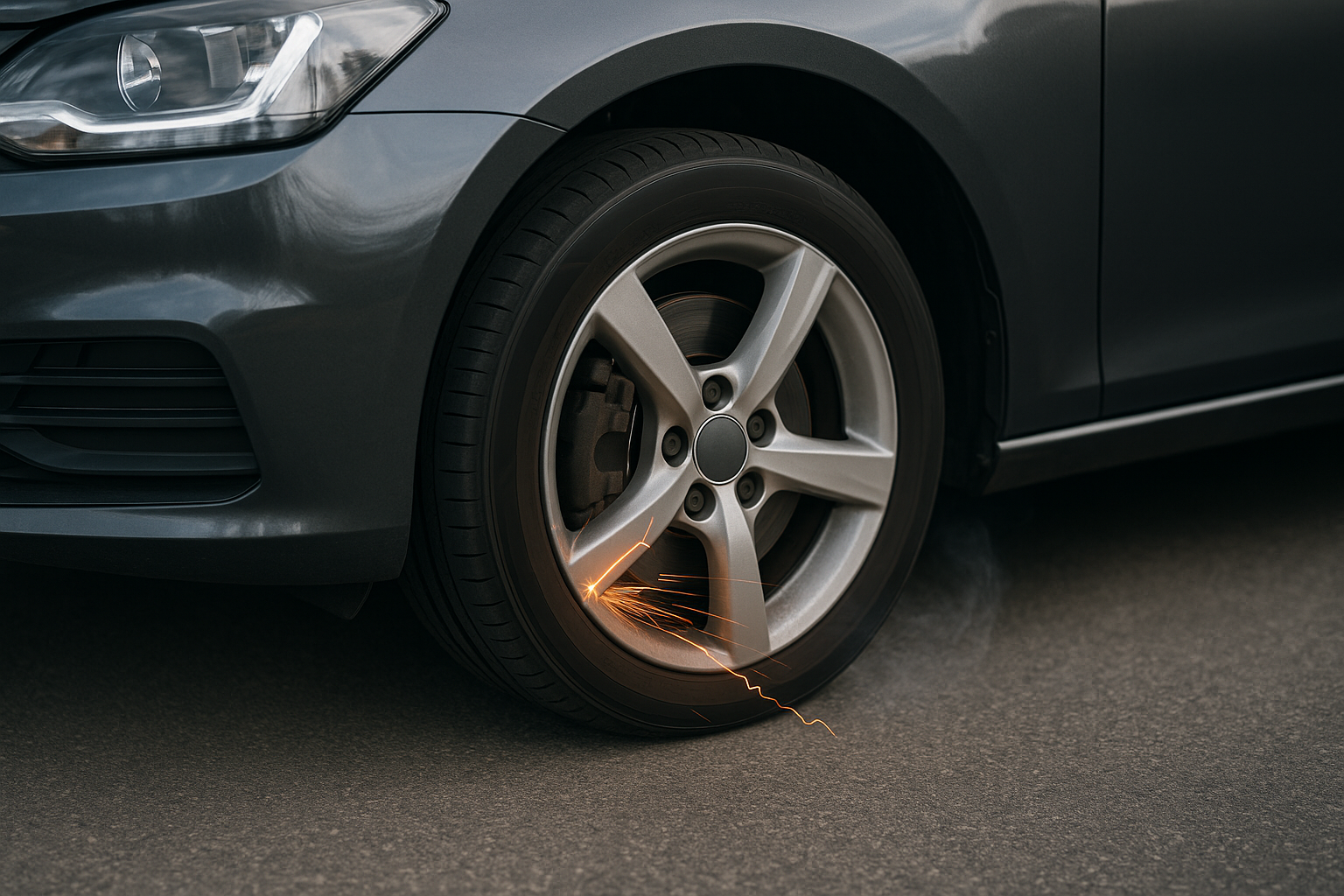
A small stone caught between the brake rotor and its thin metal splash shield can cause a sharp, repetitive tick that sometimes gets louder when turning as the rotor flexes slightly. Similarly, missing, loose, or bent brake pad anti-rattle clips can click—especially during light braking in a corner. You can often spot a pebble by looking behind the rotor and lightly bending the dust shield away a few millimeters. If the sound changes with light brake pressure, suspect pad hardware or shims.
Worn Tie Rod Ends or Ball Joints
Tie rod ends and lower ball joints manage steering and suspension articulation. When they wear, they can produce clicks or clunks as steering loads change mid-turn or when transitioning from straight ahead into a turn. Unlike the steady rhythm of a CV click tied to wheel speed, these are often single or intermittent knocks at specific steering angles or when going over small bumps while cornering. Excessive play here affects alignment and tire wear and can become a safety issue if a joint fails. A quick shake test—grabbing the tire at 3 and 9 o’clock for tie rods and 12 and 6 o’clock for ball joints—can reveal looseness.
Strut Mounts and Coil Spring “Bind”
Front strut assemblies have a bearing at the top mount that allows the spring and strut to rotate as you steer. If the bearing seizes or the spring isn’t seated correctly, the spring can wind up and release with a click or pop, especially at parking-lot speeds or when turning the wheel at a stop. You may also hear a groan or feel notchiness in the steering. Inspect the upper mount while a helper turns the steering slightly left and right with the engine running; the mount should rotate smoothly without jumping.
Sway Bar Links or Bushings
Short sway bar links and worn anti-roll bar bushings can click or tap on small bumps, and the noise can be more noticeable while turning because the bar is under torsion. These noises are usually irregular rather than a perfect rhythm that tracks wheel speed. If the sound appears over driveway lips or patched pavement, especially during a gentle turn, check links and bushings for play.
Wheel Bearing or Hub Assembly
Wheel bearings more commonly hum, growl, or roar, changing with speed and subtly with steering input—louder when you load the bad side during a turn. That said, a failing bearing or hub with damaged ABS tone rings or shields can occasionally click. If the noise changes significantly when you swerve gently left and right at a steady speed, compare sides: louder when turning left often implicates the right bearing (the outside of the turn is more loaded). Any heat at the hub after a drive or roughness when spinning the wheel off the ground backs up a bearing diagnosis.
AWD/4WD Hubs and Rear Axle Joints
On vehicles with part-time or automatic four-wheel drive, front locking hubs or disconnect mechanisms can click if they’re partially engaged or worn. Some vacuum-actuated hubs chatter during turns when vacuum lines leak. Rear CV joints on independent rear suspensions can also click in tight turns. If you hear the noise from the rear while maneuvering into a parking spot, inspect rear axle boots just like the fronts and check for grease splatter.
How to Pinpoint the Source at Home
- Do the empty-lot circle test. In a safe, open area, drive slow circles to the right, then to the left. Note when the clicking is loudest. Clicking that’s strongest on right-hand circles typically points to the left outer CV joint, and vice versa. A steady, rapid tick tied to wheel speed during these circles strongly suggests a CV issue.
- Listen for other patterns. A single knock at a certain steering angle hints at a ball joint, tie rod, or strut mount. A tick that changes or disappears with light braking can be brake hardware. A hum that grows with speed and changes subtly with steering suggests a wheel bearing.
- Check for flung grease. Park on level ground, set the brake, and safely chock the wheels. Look at the inside of the front rims, control arms, and the back of the steering knuckle. Dark grease splatter plus a torn CV boot strongly supports an outer CV diagnosis.
- Inspect boots and shields. Turn the front wheels fully left and right to access the outer CV boots. Look for cracks, tears, or loose clamps. Peek behind the brake rotor to ensure the metal dust shield isn’t touching the rotor and that no pebble is lodged there.
- Verify wheel security. With a torque wrench if possible, check lug nuts for proper torque using the manufacturer’s spec. If any clicking disappears after tightening, you likely found the problem—do not keep driving beforehand.
- Check for play. Jack up the suspect corner securely and support it with a stand; never rely on a jack alone. Grasp the tire at 12 and 6 o’clock and rock it (ball joint/hub play), then at 3 and 9 o’clock (tie rod play). Any noticeable clunk or movement needs professional evaluation.
- Spin and listen. With the wheel off the ground, rotate it by hand. A rhythmic scrape suggests debris or a bent shield; a rough, gravelly feel can be a bearing. CV clicking often won’t present without steering angle and load, so silence here doesn’t clear a CV joint.
When You Can Drive and When to Park It
Loose lug nuts, severe wheel bearing play, or a tie rod/ball joint with obvious looseness means park it and fix it before driving again. These issues can become dangerous quickly.
A clicking CV joint generally allows short local driving if the boot just failed and the clicking is recent and mild, but schedule repairs soon. Aggressive driving, full-throttle acceleration while turning, and long trips can accelerate failure. If the clicking is loud even in gentle turns or you feel binding in the drivetrain, tow it.
Debris in the brake shield is usually an annoyance more than an immediate hazard, though a rock can score the rotor if ignored. A noisy hubcap is harmless but easy to misdiagnose, so rule it out early.
Repair Options and Typical Costs
| Likely cause | What you’ll notice | Urgency | Typical fix | Ballpark cost (US) |
|---|---|---|---|---|
| Outer CV joint/axle | Rapid clicking in tight turns; grease flung inside wheel | Soon | Replace axle shaft (both boots and joints new) | $300–$900 per axle |
| CV boot only (joint still quiet) | Torn boot, little/no noise yet | Soon | Replace boot and repack grease (or replace axle) | $150–$350 boot; $300–$900 axle |
| Loose lug nuts | Click/clunk that worsens while turning | Immediate | Torque lugs to spec; inspect wheel/hub | $0–$50 (damage extra) |
| Hubcap/center cap | Tick at wheel speed, louder on bumps/turns | Low | Refit or replace cap/retainer ring | $10–$60 |
| Debris or bent brake shield | Sharp tick/scrape changing with brake input | Low | Remove debris; adjust/bend shield | $0–$150 |
| Tie rod end or ball joint | Click/knock at certain angles or over small bumps | High | Replace worn joint; alignment after | $200–$600 each |
| Wheel bearing/hub | Hum/growl changes with steering; occasional click | High | Replace hub/bearing assembly | $250–$600 per side |
| Strut mount/bearing | Click/pop at low-speed steering; notchiness | Medium | Replace strut mount (often with strut) | $250–$700 per side |
| Sway bar link/bushing | Clicks/clunks on small bumps, more in turns | Medium | Replace link/bushings | $100–$250 per link |
| Axle nut/spline issue | Click under load, wheel center movement | High | Retorque axle nut; repair/replace hub or axle if worn | $50–$500+ |
Notes: Many axle nuts are single-use, staked designs that must be replaced and torqued to a precise spec. After tie rod, ball joint, or control arm work, budget for an alignment. For CV axles, quality varies—new OEM or high-quality aftermarket axles typically last longer and run smoother than some remanufactured units.
Preventing the Noise Next Time
Check CV boots at every oil change and after winter. Replace a weeping or cracked boot before grit chews up the joint. Avoid full-lock, hard-throttle launches that stress outer CVs. After any wheel or brake work, torque lug nuts in a star pattern with a torque wrench, not an impact gun alone. If you hear any new tick or knock after service, recheck wheel hardware promptly. Keep brake areas clean and ensure pad hardware is reinstalled correctly. During tire rotations, inspect tie rods, ball joints, sway bar links, and strut mounts for early play. Avoid curb strikes and deep potholes that can damage boots, bend shields, and stress joints.
Myths and Facts About Clicking in Turns
- Myth: Clicking in a turn means low power steering fluid. Fact: Low fluid causes a whine or groan, not a rhythmic click tied to wheel speed.
- Myth: Wheel bearings usually click. Fact: They typically hum or growl; a steady click in tight turns points more to CV joints.
- Myth: Packing more grease into a torn boot will fix the click. Fact: Once an outer CV clicks, the wear is done; the joint or axle needs replacement.
- Myth: Only high-mileage cars have CV issues. Fact: One torn boot or a harsh impact can shorten a joint’s life at any mileage.
- Myth: If it only clicks at parking-lot speeds, it’s harmless. Fact: That’s exactly when CV clicks show up; address it before it worsens.
Frequently Asked Questions
Does clicking when turning always mean a bad CV joint?
No, but it’s the leading cause—especially if the clicking is rapid, steady with wheel speed, and loudest during tight, low-speed turns. Other culprits include brake debris, loose lug nuts, worn tie rods or ball joints, strut mounts, sway bar links, and wheel bearings. A quick inspection for torn CV boots and flung grease is a strong indicator.
Which side is bad if it clicks only on right turns?
The outside wheel of a turn is loaded more. So if the noise is a classic CV click and it’s louder in right-hand circles, the left outer CV joint is usually the one failing. Listening from outside the car while a helper drives slow circles can make the side more obvious.
Is it safe to drive with a clicking CV joint?
Short, gentle trips around town are often possible if the noise is mild and recent, but the joint can deteriorate quickly with full steering angle and acceleration. Avoid long drives and hard turns until it’s repaired. If the clicking is loud or you feel binding or vibration under power, get it towed.
Can a wheel bearing make a clicking noise when turning?
Occasionally, but wheel bearings more commonly hum or growl and change subtly with steering input. A rhythmic click that appears mainly in tight turns points more toward an outer CV joint. If the sound also changes with speed in a straight line and you feel roughness when spinning the wheel off the ground, check the bearing.
Should I replace just the torn CV boot or the whole axle?
If the boot just tore and the joint is silent and smooth, a boot replacement and fresh grease can save the joint. Once a joint clicks, the hardened surfaces are pitted and the noise won’t be cured by a boot; replacing the axle shaft (or the joint where serviceable) is the reliable fix.
Why does it click only at low speeds or tight turns?
Outer CV joints make the most angle at low-speed, tight steering, which exaggerates wear-related play and produces the click. At higher speeds the steering angle is smaller, so the joint isn’t stressed the same way and the noise can fade. Other parts like strut mounts and sway bar links also tend to speak up most during slow, high-angle steering.
Will an alignment fix a clicking sound when turning?
An alignment won’t stop a mechanical click from a worn CV joint, loose hardware, or failing joint. However, if worn tie rods or ball joints are replaced to cure a click or clunk, an alignment is needed after those repairs to protect your tires and ensure proper handling.