
Quick Answer
To negotiate the price of a new car, research the vehicle’s invoice and real-world market price, then request itemized out-the-door (OTD) quotes from several dealers’ internet sales departments. Focus the negotiation on OTD price, keep your trade-in and financing separate, use a preapproved loan as leverage, and be ready to walk. Time your purchase toward the end of a month or quarter or when model-year changeovers happen. Once you have the best written offer, ask a competing dealer to beat it, and finalize only when you have a signed buyer’s order matching the agreed terms.
Know the Numbers Before You Step In
MSRP, Invoice, and Market Price
The window sticker shows MSRP, but dealers pay an invoice price that’s typically a few percent lower. Hidden elements like dealer holdback and factory-to-dealer incentives can add margin beyond the MSRP-to-invoice gap. Your target should reflect current market conditions: when supply is healthy you can often land between invoice and 1–2% above invoice (minus any rebates). On low-supply or high-demand models, expect pricing close to MSRP, and sometimes an additional dealer markup (ADM). Check multiple sources—manufacturer sites, third-party pricing tools, and local listings—to triangulate a realistic target for your ZIP code.
Incentives: Consumer vs. Dealer
Factories run two broad incentive types. Consumer incentives are advertised offers—rebates, loyalty or conquest bonuses, and low APR deals—shown on the brand’s website. Dealer incentives (often called dealer cash) are unadvertised funds paid to the store for selling certain models or trims and can vary by region and month. Ask directly, “Are there any dealer incentives or Flex Cash on this VIN?” and confirm eligibility details like residency, loyalty requirements, and whether incentives can be stacked. Also verify if you must choose between a low APR and a cash rebate, and run the math on both scenarios.
The Out-the-Door Price
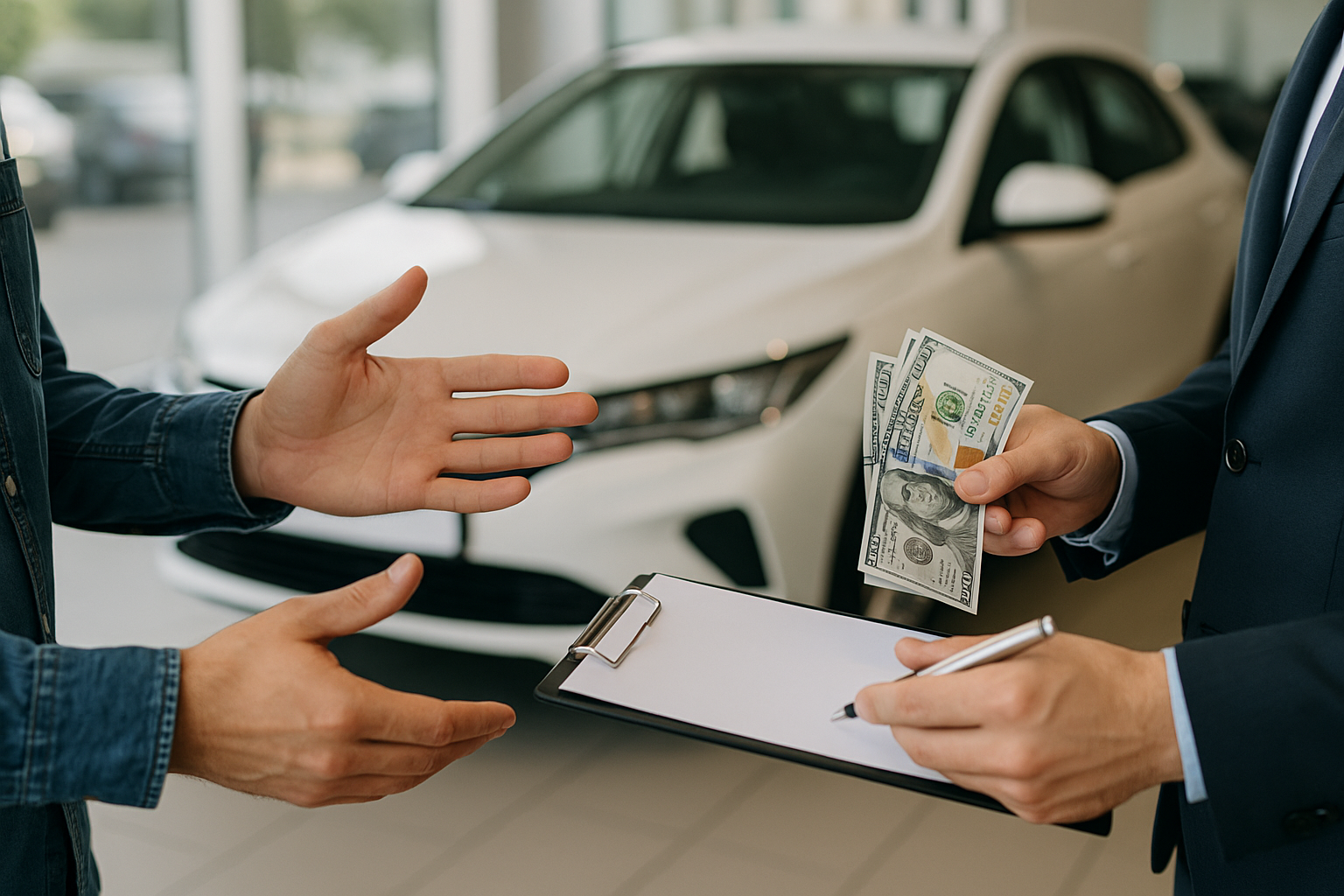
Negotiate the OTD price—the total you will actually pay, including vehicle price, destination, doc fee, taxes, title, and registration. Dealers may quote a low selling price then add accessories or fees later. Ask for an itemized buyer’s order that lists every line item and the VIN. Avoid negotiating monthly payments; a dealer can meet a monthly target by extending the term or raising APR without improving the real price.
| Charge | Typical Status | Tips |
|---|---|---|
| Destination/Freight | Non-negotiable | Factory-set; should match the Monroney sticker. |
| Doc/Processing Fee | Often fixed by dealer/state | You may not remove it; negotiate the selling price down to offset it. |
| Taxes, Title, Registration | Non-negotiable | Based on your state/county; verify with your DMV or a tax calculator. |
| Advertising or “Admin” Fees | Sometimes negotiable | Push back or ask to reduce the vehicle price by the same amount. |
| Dealer-Installed Accessories | Negotiable or removable | Request removal or a deep discount on items like nitrogen, VIN etch, and protection packages. |
Prep Your Leverage
Get Preapproved Financing
Secure a preapproval from a credit union or bank before you start shopping. This anchors your maximum APR and gives you a clear monthly and total cost baseline. Dealers can sometimes beat outside rates through captive finance promotions, but your preapproval prevents surprises and “payment packing.” If the dealer offers a lower APR, accept it only if the OTD total is equal or lower and no add-ons are required. Note that some promotions require you to choose between a rebate and a low APR—compare both by total cost, not just rate.
Handle the Trade-In as a Separate Deal
Keep your new car price negotiation separate from your trade-in. Get online valuations and at least one written cash offer (e.g., instant-offer platforms or wholesale bidders) so you have a floor. In states that credit trade-ins against sales tax, factor the tax savings into your comparison between a dealer trade allowance and an outside sale. Only fold the trade into the deal after you’ve nailed down the new car OTD number.
Timing Helps—When You Can Be Flexible
Sales teams have monthly and quarterly targets, and manufacturers use stair-step bonuses tied to those goals. You’ll often get better engagement at month-end, quarter-end, or when the next model year is arriving and dealers want to clear old stock. Slow weekdays or bad weather can also help. Timing can’t beat severe shortages, though—if supply is tight or the model is brand-new, discounts may be minimal.
| When to Shop | Why It Can Help |
|---|---|
| End of Month/Quarter | Stores chase volume bonuses; managers get more flexible to hit targets. |
| Model-Year Changeover | Outgoing model years discounted to make room for new arrivals. |
| Weekdays/Evenings | Less foot traffic; more time to respond to detailed OTD requests. |
| Late in the Day | Managers may prefer a fast, clean deal to lock a unit. |
| High Inventory Periods | More dealer swaps available; increased competition on price. |
Get Competing Quotes the Smart Way
Start with Internet Sales
Contact internet or fleet sales departments rather than walking in. Provide the exact trim, must-have options, and preferred colors, and ask for a VIN-specific OTD quote with an itemized buyer’s order. State that you are comparing multiple dealers and will buy this week from the store that provides the best written OTD with no add-ons.
- Ask for: selling price, destination, doc fee, taxes, title, registration, and any dealer-installed items.
- State that you do not authorize accessories beyond the factory build without prior written approval.
- Request confirmation that there is no Additional Dealer Markup (ADM) or that it’s included in the OTD total.
- Provide your ZIP code for accurate taxes, but withhold trade-in details until after you get the new car OTD.
Sample Message You Can Send
Hello [Name], I’m ready to purchase a new [Year Make Model Trim] this week. Please email a VIN-specific, itemized out-the-door quote including selling price, destination, doc fee, taxes, title, registration, and any dealer-installed accessories. I’m seeking the best written OTD quote and will buy from the dealer that provides it. I have outside financing preapproved but will consider captive financing if it lowers the OTD total. Thank you.
Negotiate the Offer
Set a Realistic Target
Start with your best written OTD quote and ask another dealer to beat it by a small, specific amount. On mainstream models with normal supply, a competitive deal often lands around invoice to 1–2% over invoice before subtracting consumer rebates. Luxury brands, specialty trims, and new releases tend to carry smaller discounts, and in short-supply situations you may need to aim for MSRP or focus on removing accessories and markups. Keep the conversation on OTD totals and avoid rehashing individual line items once a number is agreed.
Counter with Clarity
When you counter, cite the competing offer, attach it if possible, and give a short deadline. For example: “I have an OTD quote of $34,980 on VIN ending 1234 from [Dealer A]. If you can do $34,650 OTD on a comparable VIN by end of day, I’ll leave a deposit and schedule pickup tomorrow.” This keeps the negotiation concrete and signals you’re a serious buyer.
Refuse Markups and Forced Add-Ons
If a dealer insists on paint protection, nitrogen, window etching, or similar packs, ask to remove them or discount them to near cost. If they won’t, ask another dealer to locate the car without add-ons or to swap inventory. You can also pivot to ordering the vehicle at an agreed price with no add-ons. For unavoidable pre-installed items, demand a corresponding reduction in selling price.
Don’t Negotiate Payments
Avoid “What monthly payment do you need?” Anchoring on payments lets the store stretch loan terms or raise APR. Provide your own math: “I’m approved at X% APR for 60 months. If we agree to $Y OTD, my payment is about $Z. Let’s finalize the OTD number and I’ll sign today.” If they can beat your APR, they can present that after the OTD price is fixed.
Seal It in Writing
Before you go to the store, ask for a signed buyer’s order or purchase agreement showing the VIN, selling price, each fee, taxes, incentives, and the OTD total. If leaving a deposit, use a credit card and confirm in writing whether it’s refundable and under what conditions. Bring the document to the dealership and compare it, line by line, to what you’re asked to sign. If anything changes, pause and renegotiate or walk away.
At the Dealership and in the Finance Office
Inspect the Car You’re Buying
Match the VIN on the contract to the car on the lot. Verify color, options, and mileage (should be minimal), and check for dings or transport damage. Ask for the window sticker, both keys, floor mats, spare tire or inflator kit, and any charging cable for plug-ins. Note anything missing on a due bill before signing.
Navigate F&I Upsells
The finance manager may offer extended warranties, GAP coverage, tire/wheel protection, and other add-ons. These are optional and often negotiable. You can usually buy a manufacturer-backed extended warranty any time before the basic warranty expires, sometimes at better rates from authorized online dealers. GAP may make sense if you’re putting little down or have a long term; compare your lender’s GAP price before signing. Decline products you don’t understand and don’t let pitches delay printing the base contract.
Check the Contract Details
Verify APR and term, confirm no prepayment penalty, and ensure every agreed incentive is applied. Watch for “spot delivery” or “yo-yo” language that lets the dealer unwind the deal if financing “doesn’t fund.” If you’re taking delivery before funding is final, get written confirmation that the deal is not conditional. Triple-check the VIN and OTD total.
Special Cases
Electric Vehicles and Rebates
EV pricing can hinge on federal, state, and utility incentives. Some federal clean-vehicle credits can be applied at the point of sale if the dealer is enrolled and the vehicle and buyer meet eligibility rules; others are claimed at tax time. State programs and utility rebates vary. Confirm current IRS guidance and your state’s rules before negotiating, and clarify in writing whether the dealer is applying a credit to reduce your OTD price or if you will claim it later. Because EV supply and demand vary widely, some models transact near MSRP while others see sizable discounts—use local listings to set expectations.
Factory Orders and Price Protection
If you custom-order, ask for a signed purchase agreement locking the selling price or explicitly stating a discount relative to MSRP. Clarify estimated delivery, deposit terms, and whether incentives are protected at order date, delivery date, or whichever is better. Get the full build sheet and confirm no dealer add-ons will be installed without your approval.
Common Dealer Tactics and How to Respond
- Monthly payment focus: “Let’s finalize the out-the-door price; we can address payments after.”
- Four-square shuffle: Keep trade, financing, and new car price separate and in writing.
- Today-only price: “Email me the buyer’s order with that price. If it’s good today, it will be good when I arrive.”
- Added accessories after agreement: “Remove them or reduce the selling price by the same amount.”
- Rate bump: Present your preapproval and ask the dealer to beat the APR without changing the OTD total.
- Lowball trade then raise price: Negotiate OTD first; introduce the trade only after the new car price is set.
- Holding your keys: Bring a spare, or don’t hand over keys or registration until you’re ready to proceed.
A Simple Step-by-Step Plan
- Research: Know invoice, realistic market price, incentives, and your tax rate.
- Preapprove: Secure financing and set your budget by OTD total, not payments.
- Quote: Email 5–8 internet departments for VIN-specific, itemized OTD offers.
- Compare: Eliminate quotes with forced add-ons; rank the rest by lowest OTD.
- Counter: Ask a competitor to beat the best OTD by a small amount and set a deadline.
- Lock it: Get a signed buyer’s order with VIN and OTD; place a refundable deposit if needed.
- Inspect and sign: Verify the car, contract, and financing match your agreement; decline unwanted add-ons.
Frequently Asked Questions
How much below MSRP can I realistically expect on a new car?
It depends on supply, demand, and brand. On mainstream models with normal inventory, landing near invoice to 1–2% over invoice (before rebates) is common. Hot new releases, specialty trims, and short-supply vehicles may transact at MSRP or include dealer markups. Check local listings and recent sales data in your region to set a realistic target.
Is paying cash better for negotiating?
Cash doesn’t always get you a lower price because dealers often earn reserve income on financing. The best approach is to negotiate the OTD price first as if paying cash, then decide whether to use your preapproved loan, dealer financing, or cash. If the dealer can beat your APR without changing the OTD number, take the savings.
Should I reveal my trade-in early in the process?
No. Get your new car OTD price locked first. Then present your trade along with written outside offers for comparison. This prevents a dealer from juggling numbers between the new car price and your trade allowance to obscure the real deal.
What if a dealer won’t provide an itemized OTD quote by email?
Thank them and move on to dealers who will. Stores that refuse written OTD quotes often rely on in-person tactics. You can circle back if inventory is scarce, but make it clear that a sale requires a written, itemized OTD with the VIN.
Are doc fees legitimate, and can I refuse to pay them?
Doc fees are common and, in some states, effectively fixed. You may not be able to remove the fee, but you can negotiate the selling price to offset it. Focus on the final OTD total rather than any single line item.
Does timing at the end of the month still help with low inventory?
It can, but it won’t override severe shortages. End-of-month and quarter timing gives managers more incentive to make a deal, yet if the lot has just a handful of high-demand units, discounts may still be minimal. You’ll see the biggest timing benefit when inventory is healthy or on outgoing model years.
Can I negotiate a factory-ordered vehicle?
Yes. Negotiate the selling price or discount relative to MSRP up front and get it in writing. Confirm whether incentives are locked at order date, delivery date, or whichever is better, and state that no dealer add-ons will be installed without your approval.