
Quick Answer
MSRP stands for Manufacturer’s Suggested Retail Price—the “sticker price” the automaker recommends a dealer charge for a vehicle. It’s a starting point, not the final price. Depending on supply, incentives, and dealer practices, you might pay below MSRP, at MSRP, or above it. What you actually owe is the out-the-door price, which adds taxes and fees to the negotiated selling price.
What MSRP Really Means
MSRP is the automaker’s publicly suggested price for a specific trim and its factory-installed options. It appears on the federally mandated window sticker (the Monroney label) to provide a consistent baseline across dealers. Crucially, MSRP is not a legal requirement. Franchised dealers are independent businesses and can set asking prices based on local demand, inventory costs, and competition.
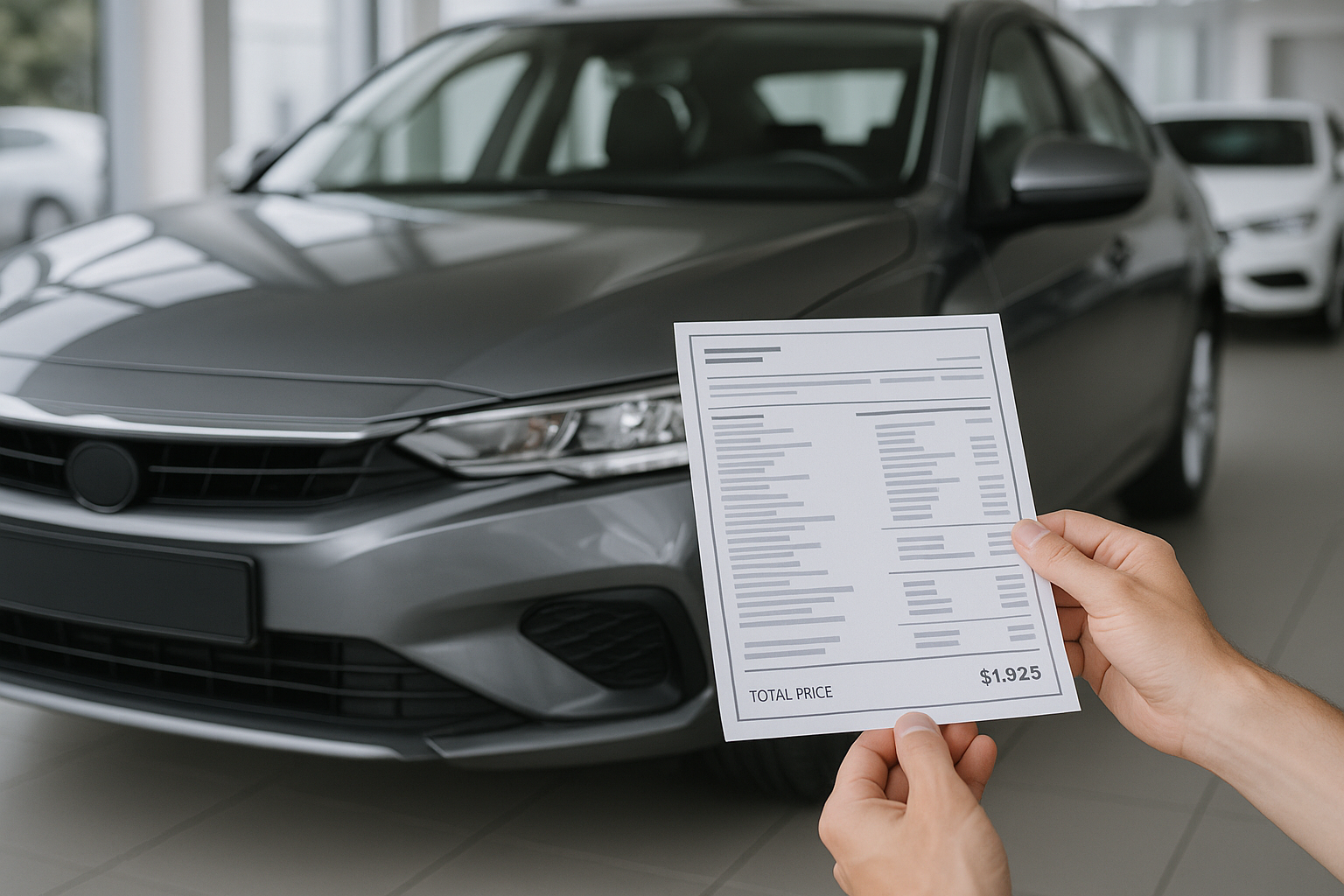
On the window sticker, you’ll typically see a breakdown: base MSRP, the cost of factory options and packages, a subtotal, and a destination charge, followed by a “total price.” Many shoppers and salespeople refer to that total as “MSRP,” even though the destination fee appears as a separate line. Taxes, title, registration, documentation fees, and dealer-installed accessories are not part of MSRP.
What’s on the Window Sticker (Monroney Label)
The Monroney label is more than a price tag. It details what you’re paying for and what comes standard. Expect to see:
- Base MSRP for the trim level
- Factory options and packages with their prices
- Destination charge (shipping the car to the dealer)
- “Total price” (base + options + destination)
- EPA fuel economy estimates and emissions info
- Safety ratings (if available)
- Parts content and assembly location
Dealer add-ons—paint protection, window tint, nitrogen in tires, wheel locks, aftermarket alarms—appear on a separate dealer addendum, not the factory Monroney. Those items are not included in MSRP and are negotiable. Note that the Monroney label is required on new vehicles; used cars typically won’t have one.
MSRP vs. Other Car Pricing Terms
MSRP isn’t the only number you’ll encounter in a car deal. Here’s how it compares to the figures that drive what you pay.
| Term | What it is | What’s included | Negotiable? | Who sets it |
|---|---|---|---|---|
| MSRP | Automaker’s suggested selling price | Base price + factory options; destination shown separately and often included in “total” | Yes | Manufacturer |
| Invoice Price | Amount the manufacturer bills the dealer | Base + options + destination + some regional fees (e.g., advertising); excludes holdback | Not directly, but you negotiate the selling price relative to it | Manufacturer |
| Dealer Holdback | Money paid back to the dealer after sale | Typically 1–3% of MSRP; offsets carrying and marketing costs | No (it’s behind the scenes) | Manufacturer |
| Market Adjustment | Dealer markup in high-demand markets (often labeled ADM) | Pure markup, sometimes shown as a line item | Yes | Dealer |
| Selling Price | The negotiated vehicle price before taxes/fees | MSRP adjusted by discounts, incentives, markups, and add-ons | Yes | Dealer and buyer |
| Out-the-Door Price (OTD) | Total you pay to take the car home | Selling price + taxes + title/registration + doc fee + other mandatory fees | Only the selling price and discretionary fees | Dealer and state/local authorities |
| Market Price | What similar buyers are actually paying | Reflects supply/demand and incentives in your area | It’s a benchmark, not a line item | Set by the market |
Why You Sometimes Pay Above or Below MSRP
When prices go above MSRP
During shortages or for hot new models, dealers may add a “market adjustment” or bundle high-margin add-ons. Limited-run performance trims, newly released EVs, and popular SUVs often carry premiums when local demand exceeds supply. In these cases, bargaining below MSRP is difficult unless you’re willing to order and wait, shop a less competitive region, or target a different trim or color.
When prices fall below MSRP
In a competitive market with ample inventory, dealers discount below MSRP to move cars, hit monthly or quarterly targets, or clear outgoing model years. Discounts tend to be larger:
- At model-year changeover
- On slow-selling trims or colors
- At the end of the month or quarter
- When factory-to-dealer incentives stack with customer rebates
How Incentives and Rebates Affect the Price
MSRP doesn’t account for incentives. These programs lower your effective cost and can come from either the manufacturer or the dealer.
- Customer cash rebates: Reduce your price at purchase. In some states, these are taxable; rules vary.
- Low-APR or subvented leases: Lower financing or lease costs, sometimes in lieu of cash rebates.
- Dealer cash: Paid by the manufacturer to the dealer to help discount vehicles; not always disclosed to buyers.
- Loyalty, conquest, college, and military programs: Targeted discounts for qualifying customers.
- Regional incentives: Vary by ZIP code and inventory mix; eligibility can change monthly.
Incentives frequently change and may be mutually exclusive. Always verify current offers on the automaker’s site and compare multiple pricing guides. When reviewing advertisements, confirm whether the quoted price includes conditional incentives you don’t qualify for.
Fees You Can and Can’t Negotiate
Understanding fees helps you compare quotes accurately and avoid surprises.
- Destination charge: Set by the manufacturer and shown on the window sticker. Generally non-negotiable.
- Documentation (doc) fee: Covers paperwork processing. Capped in some states and high in others. Usually fixed at a store level, but you can ask the dealer to offset it by lowering the selling price.
- Title, registration, and state inspection: Government fees. Non-negotiable.
- Dealer add-ons (VIN etch, paint sealant, wheel locks, nitrogen, window tint): Fully negotiable. You can decline them or negotiate their price.
- Advertising or “TDA” fees: Often embedded in invoice pricing as a regional pass-through. You likely won’t remove them, but you can negotiate the overall selling price.
Example: From MSRP to Out-the-Door
Here’s a simple illustration of how MSRP translates into what you actually pay.
- Base MSRP: $31,000
- Factory options: $1,500
- Destination charge: $1,295
- Total on window sticker: $33,795
- Negotiated discount: -$1,800
- Dealer add-ons you accept: +$300
- Manufacturer customer cash: -$750
- Selling price after incentives/add-ons: $31,545
- Sales tax (example 7% on taxable amount): $2,208.15
- Title/registration: $350
- Doc fee: $399
- Out-the-door total: $34,502.15
This breakdown shows why focusing on out-the-door price is key. Two dealers might advertise “$2,000 off MSRP,” yet one tacks on $1,500 of add-ons while the other doesn’t—making the first deal worse despite a similar headline discount.
Negotiation Tips: Using MSRP the Smart Way
MSRP frames the conversation, but market data wins deals. Use these steps to anchor negotiations to real numbers.
- Research the market price. Check multiple sources (pricing guides, forums, recent sales data) for what buyers pay in your ZIP code. If the market average is 4% below MSRP for your model, that’s a realistic target.
- Know the invoice range. Invoice isn’t dealer cost, but it helps you gauge room to move—especially when dealer cash or holdback are in play.
- Ask for a line-item quote. Request an itemized purchase order with selling price, add-ons, incentives (identify which are conditional), and all fees. Decline unwanted add-ons before discussing payments.
- Negotiate the out-the-door price. Taxes are set by law, but push back on the selling price and discretionary fees. Compare OTD numbers across dealers for apples-to-apples accuracy.
- Separate the trade-in and financing. Get a clean OTD offer first. Then negotiate your trade value and shop financing with your bank or credit union to prevent one number masking another.
- Be flexible on color/options or location. A dealer 50 miles away with excess inventory may beat a nearby store with tight supply.
- Consider ordering. If local inventory is marked up, placing a factory order at MSRP or a modest discount can beat paying a premium for what’s on the lot.
Leases: Why MSRP Matters Even More
Leases use MSRP to calculate residual value, which heavily influences your monthly payment.
- Residual is a percentage of MSRP, not your negotiated price. Higher residuals lower the payment.
- Your negotiated discount lowers the capitalized cost (cap cost). Bigger discount = lower monthly payment.
- The money factor (the lease’s interest rate) and factory lease incentives can rival or exceed cash rebates.
Because residual is tied to MSRP, two cars with the same selling price can lease very differently if one has a stronger residual or better money factor. Compare lease programs—not just discounts—when evaluating payments.
EVs and MSRP Caps for Tax Credits
For qualifying new electric vehicles, a federal clean vehicle credit (up to $7,500) may be available and, in many cases, can be applied at the point of sale if the vehicle and buyer qualify. The law sets MSRP caps by vehicle category; if the vehicle’s MSRP for that trim and options exceeds the cap, the credit isn’t available. The cap uses the stickered MSRP for that configuration, not your negotiated price. As of current rules, the cap is generally $55,000 for cars and $80,000 for SUVs, vans, and pickup trucks.
Eligibility also depends on income limits, final assembly in North America, and battery content/sourcing. Always verify real-time eligibility on the IRS site and with the dealer, since vehicle content and program status can change. State and local rebates may stack and often have their own price caps and rules.
How MSRP Interacts with Insurance and Depreciation
Insurers price policies using a vehicle’s actual cash value, repair costs, and loss data, but higher-MSRP vehicles often carry higher premiums because parts and replacement costs are greater. Depreciation also starts from MSRP; models that commonly transact far below MSRP can show steeper first-year percentage drops on paper, even if your loss versus the negotiated price is smaller. In practice, market demand, brand reputation, incentives, and fleet sales history influence resale more than MSRP alone.
Common Misconceptions About MSRP
- “MSRP is what I’ll pay.” Sometimes, but not always. It’s a suggestion, not a contract.
- “Invoice equals dealer cost.” Not exactly. Holdback and dealer incentives can lower the dealer’s true cost below invoice.
- “Destination is a dealer fee.” It’s set by the manufacturer and appears on every window sticker for that model. Dealers typically can’t waive it.
- “Add-ons are mandatory.” Only if you agree. You can refuse dealer-installed accessories or negotiate them.
- “You can always buy at invoice.” In hot markets you might pay over MSRP; in soft markets you might beat invoice.
How to Use MSRP to Compare Offers
MSRP helps normalize quotes across trim levels and options. When two cars have different equipment, compare the discount as a percentage off MSRP to see which dealer is truly more aggressive. For example, 6% off a $40,000 MSRP ($2,400 off) might beat $2,000 off a $41,500 MSRP, especially if the higher-MSRP vehicle bundles options you don’t value. Then carry that comparison through to out-the-door totals to account for fees and taxes.
Regional and Timing Factors
Prices tied to MSRP move with local supply and calendar timing. Coastal metros with heavy demand may hold closer to MSRP, while rural markets compete harder on price. Month- and quarter-end sales targets often unlock deeper discounts. Model-year changeovers and redesign cycles matter too: outgoing models tend to sell below MSRP, while fresh redesigns hold closer to it until production ramps up.
Bottom Line: What MSRP Means for Your Wallet
MSRP is the anchor. Your deal floats up or down from it based on market conditions, incentives, and dealer strategy. Treat MSRP as a benchmark, verify current incentives, insist on itemized quotes, and negotiate the out-the-door price. That’s how you turn a suggested price into a fair deal.
Frequently Asked Questions
Does MSRP include destination, taxes, and fees?
The window sticker shows base MSRP and options, plus a separate destination charge, then a total. Taxes, registration, and dealer fees are not included. Many people casually refer to the sticker’s total as “MSRP,” but government fees and dealer add-ons are always extra.
Is paying above MSRP ever reasonable?
It can be with limited supply or high-demand launches. If waiting months or traveling isn’t practical, paying a small premium may make sense. Still, ask if you can order at MSRP, shop other dealers, or choose a similar trim with fewer add-ons or a less in-demand color.
How close to invoice can I expect to pay?
In a competitive market, selling prices commonly land between invoice and several percent below MSRP, sometimes below invoice when dealer cash is strong. In tight markets, expect prices at or above MSRP. Use real transaction data for your area as your guide.
Are manufacturer rebates taxed?
Rules vary by state. In many places, manufacturer rebates are treated as part of the purchase price and are taxable; trade-in credits often reduce the taxable amount. Ask the dealer to show how tax is calculated on your buyer’s order, or confirm with your DMV.
Can the destination charge be waived?
No. The destination fee is set by the automaker and applies to every vehicle of that model, regardless of where you buy it. If you want to offset it, negotiate the vehicle’s selling price instead.
How does MSRP affect a lease payment?
Lease residuals are calculated as a percentage of MSRP, so MSRP directly influences the residual value. Your negotiated discount lowers the cap cost. Together with the money factor and available lease incentives, those determine your monthly payment.
What’s the best way to compare two dealer quotes?
Normalize each quote by calculating the discount as a percentage of MSRP, remove any unwanted add-ons, and then compare out-the-door totals. Focusing on OTD avoids surprises from inflated fees or accessories and makes true price differences obvious.